
Table of Contents
If you’re asking whether no contact works, you’re probably not calm about it.
You’re trying to stop thinking about her.
You’re wondering if silence will make her miss you.
You’re torn between wanting peace and wanting a reaction.
That tension is the real problem.
No contact isn’t magic.
But when used correctly, it does work—just not always in the way men hope.
No contact works after a breakup with a girlfriend when the goal is emotional reset, not control or manipulation. It reduces triggers, breaks obsessive thinking, and restores self-respect. It can sometimes lead to renewed attraction, but its real value is helping you detach, stabilise, and make clearer decisions instead of acting from anxiety.
What “No Contact” Actually Means (And What It Doesn’t)
No contact is often talked about like a tactic, but it isn’t one.
At its core, no contact means removing all non-essential communication and exposure so your emotional system can settle. That’s it. No drama. No announcement. No countdown.
In practice, no contact means you stop doing the things that keep her mentally present in your life.
You don’t text her “just to check in.”
You don’t reply to old threads out of habit.
You don’t look at her social media to see how she’s doing.
You don’t ask mutual friends for updates framed as concern.
Most importantly, you stop using contact as a way to regulate how you feel.
That’s the part most men miss.
What no contact does not mean is pretending you don’t care. If you didn’t care, you wouldn’t need distance in the first place. It also doesn’t mean cutting off necessary logistics forever. If there are shared responsibilities—kids, property, work—the goal shifts to minimal, neutral contact, not emotional silence.
No contact also isn’t a performance.
It’s not about “winning the breakup,” proving strength, or hoping she notices your absence. The moment no contact becomes something you’re doing at her, it stops serving you.
The clean version of no contact is quiet and unremarkable.
No posts. No hints. No indirect messages.
From the outside, it looks like nothing is happening.
Internally, everything is changing.
Because when you remove contact, you remove the constant emotional stimulation that keeps hope, anxiety, and obsession alive. Your mind finally gets a chance to stop reacting and start recalibrating.
That’s what no contact is really for.
Why No Contact Feels So Hard for Men
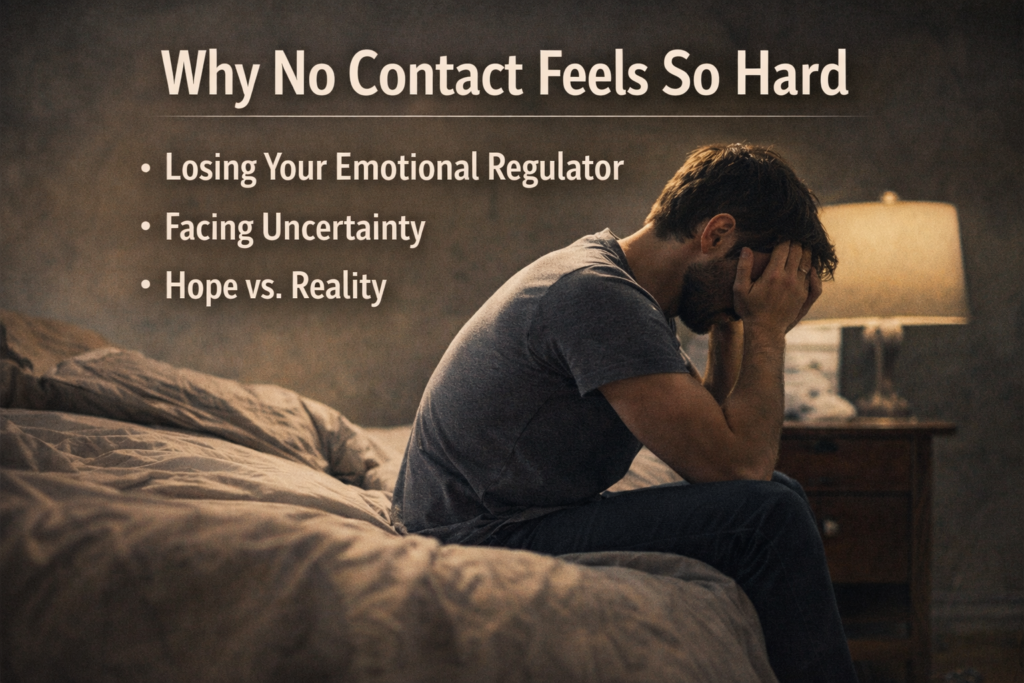
No contact feels hard for one simple reason: it removes your main emotional regulator overnight.
During the relationship—even if things were unstable—contact with her provided reassurance, familiarity, and a sense of grounding. A text, a call, or even an argument confirmed that the connection still existed. After the breakup, that outlet disappears, and your nervous system doesn’t know what to do with the sudden drop.
So it looks for relief.
That’s why the urge to reach out doesn’t feel like a thought.
It feels physical. Restless. Pressing. Almost urgent.
For many men, this is the first time they’re forced to sit with emotional discomfort without an external release. Men are often conditioned to stay functional, not reflective. You keep moving, keep working, keep training—but the internal pressure has nowhere to go.
Contact becomes the shortcut.
Another reason no contact feels unbearable is that it forces you to face uncertainty directly. When you’re talking to her—even sporadically—you’re still connected to the story. There’s still a sense of “maybe.” Silence removes that buffer.
You’re no longer reacting to her.
You’re reacting to the absence.
That absence brings up questions most men would rather avoid:
- “Is this really over?”
- “What does this mean for my future?”
- “What if I don’t find this again?”
No contact doesn’t create those fears.
It just stops distracting you from them.
There’s also a loss of perceived control.
When you can message her, you feel like you’re doing something. Even if it backfires, action feels better than helplessness. No contact removes that illusion. You’re forced to accept that you can’t manage her feelings or steer the outcome.
For men who tie self-worth to competence and agency, that loss hits hard.
Finally, no contact is difficult because it exposes hope.
As long as you’re in contact, hope has somewhere to live.
When you step back, hope either matures—or collapses.
That transition is uncomfortable, but it’s also necessary. You can’t stabilise emotionally while part of you is still scanning for signs.
This is why no contact feels like withdrawal rather than relief at first.
But that discomfort isn’t a sign you’re doing it wrong.
It’s a sign the old regulation system is shutting down so a new one can form.
Does No Contact Actually Make Her Miss You?
Sometimes, yes. Often, no. And focusing on that outcome is where most men go wrong.
No contact can create space. Space can create contrast. And contrast can, in some situations, bring awareness of what’s missing. If the relationship ended without major damage, if attraction faded slowly rather than collapsed, and if you weren’t chasing or pleading at the end, distance can reset emotional tension.
But that’s the exception, not the rule.
What no contact does not do is manufacture feelings that aren’t already there. It doesn’t undo incompatibility, fix trust issues, or override a decision that’s already emotionally complete. Silence can’t compete with clarity if she’s already moved on internally.
The reason this question causes so much pain is because it turns no contact into a test.
Every day of silence becomes loaded:
- “If she misses me, she’ll reach out.”
- “If she doesn’t, it means I didn’t matter.”
That framing is brutal—and inaccurate.
People can miss someone and still not come back.
People can care and still choose distance.
And sometimes, people don’t reach out simply because they respect the boundary.
Here’s the uncomfortable truth:
No contact only has a chance of affecting her when you stop monitoring it for results.
The moment no contact becomes a way to provoke a reaction, it keeps you emotionally attached. You’re still orienting your mood around her behaviour, even in silence.
What actually shifts attraction—when it does—isn’t the absence itself. It’s the change that happens in you during the absence. When you stop chasing, stop performing, and stop leaking anxiety into the dynamic, your energy changes. That change is what’s felt—not the silence.
And if she never misses you in the way you hope?
Then no contact still works—by pulling you out of a position where your self-worth depends on her response.
That’s the part most men don’t want to hear, but it’s the part that actually matters.
The Real Reason No Contact Works (Even If She Never Comes Back)
No contact doesn’t work because it makes you mysterious.
It works because it breaks a dysfunctional feedback loop.
After a breakup, many men stay emotionally entangled through small, ongoing interactions—texts, likes, updates, “friendly” check-ins. Each one resets the emotional wound just enough to keep it open. You never fully crash, but you never stabilise either.
No contact cuts that loop cleanly.
When the loop breaks, three things start to happen—quietly, without drama.
First, your nervous system calms down.
Without constant stimulation from her presence, your body stops cycling through hope, anxiety, and disappointment. Sleep improves. Focus returns in short bursts. The constant background tension eases. This isn’t emotional numbness—it’s regulation.
That alone changes how you think.
Second, your self-respect begins to reassert itself.
When you’re no longer chasing clarity, reassurance, or validation from someone who chose to leave, something subtle shifts. You stop negotiating your worth through access to her. You’re no longer shrinking yourself to maintain a connection that’s already broken.
That shift matters more than most men realise.
Self-respect isn’t a feeling. It’s a posture.
And posture changes how you move through the world.
Third, your perspective widens.
As the emotional fog lifts, you start seeing the relationship more accurately—not idealised, not demonised. Just clearer. You notice what wasn’t working. Where you were over-functioning. Where you were settling. Where you were hoping things would change instead of acting on what was actually happening.
This is where real detachment begins.
Not indifference—but realism.
And here’s the part that often surprises men:
If she ever does reconsider, it’s usually after this shift—not because you disappeared, but because you stopped orbiting her.
Distance alone doesn’t create attraction.
Stability does.
When you’re no longer emotionally reactive, no longer available on demand, no longer orienting your identity around the relationship, the dynamic changes. Sometimes she feels that. Sometimes she doesn’t.
But either way, you’re no longer stuck.
No contact works because it returns agency to you.
It stops the bleed.
It gives you your footing back.
Whether she comes back or not becomes secondary—because you’re no longer waiting to be chosen to feel okay.
That’s when you know it’s working.
When No Contact Is the Right Move
No contact isn’t a default rule. It’s a tool—and like any tool, it works best in specific situations.
It’s the right move when contact consistently makes you feel worse, not better.
If every interaction leaves you analysing tone, replaying messages, or wondering where you stand, contact isn’t helping you heal. It’s keeping you emotionally hooked to an outcome you don’t control.
No contact is also the right move when you notice yourself shrinking in the dynamic.
That can look like:
- Being overly agreeable just to keep communication open
- Holding back how you really feel to avoid pushing her away
- Accepting crumbs of attention and calling it progress
When contact costs you self-respect, distance is corrective.
It’s especially appropriate when the breakup has already happened clearly.
If she’s said she needs space, isn’t ready, or wants to move on, continuing to engage usually isn’t connection—it’s resistance. No contact respects the reality of the situation instead of fighting it emotionally.
Another strong indicator is obsession.
If you’re checking your phone constantly, rereading old messages, or timing your responses to avoid “looking needy,” you’re not in a stable position to be in contact. No contact gives you the breathing room to reset before you act in ways you’ll later regret.
No contact is also right when you’re hoping contact will change her mind.
That hope keeps you passive. You wait. You interpret. You react. And your life stays on hold while hers continues.
Distance interrupts that pattern.
It forces you to redirect energy back into your own structure—your routines, your health, your direction. That redirection is often what men need most after a breakup, even if it’s not what they want in the moment.
Finally, no contact is the right move when you don’t trust yourself to keep boundaries.
If you know that “just one message” turns into a spiral, the cleanest option is none at all. Boundaries aren’t about willpower. They’re about designing conditions where you don’t have to fight yourself constantly.
No contact doesn’t mean the relationship failed.
It means you’re choosing stability over emotional chaos.
When No Contact Won’t Work (And What to Do Instead)
No contact isn’t always possible—and forcing it in the wrong situations can create more stress, not less.
If you share children, complete silence usually isn’t realistic or healthy. Communication still has to happen. In those cases, the goal isn’t no contact—it’s low emotional contact. Messages stay practical, short, and focused on logistics. No emotional processing. No revisiting the relationship. No late-night conversations that reopen old wounds.
The same applies if you work together or have unavoidable professional overlap. Trying to disappear completely can create unnecessary tension or complications. Instead, keep interactions neutral, predictable, and bounded. Think of it as shifting the relationship from emotional to administrative.
No contact also doesn’t work when you’re using it to avoid reality.
If you’re refusing contact because you’re afraid to accept the breakup—or because you’re secretly hoping silence will force a dramatic return—you’re still emotionally dependent. Distance alone won’t resolve that. What’s needed instead is honest acceptance, even if it hurts.
There are also situations where the breakup itself was unhealthy or abusive. In those cases, no contact might be necessary for safety—but it won’t magically create clarity or closure. Support, boundaries, and sometimes professional help matter more than strategy.
When no contact isn’t an option, the principle stays the same:
Reduce emotional stimulation.
That means fewer messages, less depth, and no emotional ambiguity. You’re not trying to win or punish. You’re protecting your ability to stabilise.
The success of this phase isn’t measured by how she reacts.
It’s measured by whether your thinking becomes clearer and your behaviour steadier.
If distance—full or partial—moves you toward that, it’s working.
How Long Should No Contact Last?
There isn’t a correct number of days.
Anyone who gives you a fixed timeline is guessing—or selling certainty where none exists.
No contact isn’t a countdown. It’s a state change.
The real question isn’t “How long until she reaches out?”
It’s “How long until I stop feeling pulled to break it?”
At the beginning, no contact feels tense. You count days. You wonder whether enough time has passed. Every silence feels meaningful. That’s normal—but it also means you’re still emotionally oriented around her.
No contact hasn’t done its job yet.
Over time, something shifts.
The urge to check weakens.
You go longer stretches without thinking about what she’s doing.
Your mood stops rising and falling based on imaginary scenarios.
That’s the signal.
No contact has lasted long enough when you no longer feel compelled to use it as a tool. When silence feels neutral instead of strategic, you’re close.
For some men, this takes a few weeks.
For others, a few months.
What matters isn’t the calendar—it’s the internal pull.
Breaking no contact too early usually happens for one of two reasons:
- You’re seeking relief from discomfort
- You’re hoping for reassurance or clarity
Neither leads anywhere good.
If you reach out while you still want something from the interaction—validation, reassurance, a sign—you’re likely to reopen the loop you worked to close.
A better test is this:
If she didn’t respond, would you be okay?
If the answer is no, you’re not done yet.
No contact isn’t about staying away forever.
It’s about staying away long enough to regain your footing.
Once you’re stable, contact—if it happens—comes from choice, not compulsion.
That’s the difference that matters.
Common Mistakes Men Make With No Contact
The biggest mistake men make with no contact is turning it into a silent negotiation.
You don’t say it out loud, but internally you’re thinking:
“If I disappear long enough, she’ll realise what she lost.”
That mindset keeps you emotionally hooked. You’re still orienting your self-worth around whether she notices, misses you, or reaches out. Silence becomes performative instead of stabilising.
Another common mistake is breaking no contact impulsively.
You have a rough night.
You start spiralling.
You convince yourself that sending one calm, reasonable message won’t hurt.
It almost always does.
Even if she responds kindly, the loop restarts. Your nervous system spikes again. You’re back to analysing tone, timing, and meaning. The relief you feel lasts minutes. The fallout lasts days.
There’s also the mistake of monitoring her from a distance.
You’re technically in no contact—but you’re still checking her socials, reading into posts, or asking friends how she’s doing. That’s not no contact. That’s emotional surveillance.
Your brain doesn’t care whether the stimulus comes directly from her or indirectly. It reacts the same way.
Another trap is using no contact without changing anything else.
You stop talking to her, but your life stays empty. Your routines are loose. Your sleep is off. Your structure is weak. In that state, no contact feels like deprivation instead of relief.
Silence without rebuilding just amplifies the obsession.
There’s also the mistake of responding too fast if she reaches out.
When you’ve been waiting, a message feels like oxygen. You rush to reply, overshare, or fall straight back into emotional availability. The dynamic snaps back to where it was—often worse.
No contact isn’t undone by a message.
It’s undone by returning to the same posture.
Finally, many men make the mistake of waiting to feel better before moving forward.
They tell themselves they’ll focus once the thoughts stop.
They’ll rebuild once the pain fades.
They’ll act once they feel ready.
But readiness follows action, not the other way around.
No contact works best when it’s paired with movement—structure, effort, forward momentum. Without that, it turns into passive waiting.
Avoiding these mistakes doesn’t make no contact painless.
It makes it effective.
Conclusion: No Contact Isn’t About Her — It’s About You
No contact isn’t a trick to make her come back.
It’s a decision to stop bleeding emotionally and start standing on your own footing again.
After a breakup, it’s easy to confuse restraint with passivity. Silence feels like doing nothing. But when contact keeps you anxious, reactive, and stuck, stepping back is an act of self-respect—not surrender.
No contact works when it removes you from a position where your mood, confidence, and sense of worth depend on someone else’s attention. It works when it gives your nervous system time to stabilise and your thinking time to clear. And it works when you use the space to rebuild structure instead of waiting for a signal.
Sometimes, distance brings perspective for both people.
Often, it brings perspective only for you.
Either way, that perspective is the point.
If you’re honest, the real fear isn’t that no contact won’t work.
It’s that it will—and you’ll be forced to face what comes next without her as the reference point.
That’s not a loss. That’s a reset.
The right next step isn’t to wait and see what she does.
It’s to act in a way that makes you respect yourself regardless of what she does.
Use no contact as a boundary, not a strategy.
Use the space to rebuild your rhythm, your discipline, and your direction.
When that happens, the outcome matters less—because you’re no longer stuck in place, hoping for clarity from someone who already chose distance.
That’s when no contact has truly done its job.
In my full article on Relationships in 2026 I break down the exact scripts men can use to say no without guilt.
👉Want to reclaim your life?
Join My Newsletter The Honest Masculine weekly newsletter — and you’ll get instant access to my (The Masculine Comeback: A 7-Day Reset for Men Who Feel Lost). No fluff, no filters. Just raw truths about breakups, masculinity, fatherhood, and the quiet battles men face alone.
It’s for the man who’s done pretending.

If you like my content? Let me know by Buying me a coffee. Thanks 🙂