Table of Contents
Introduction: Building Self-Control When No One’s Watching
The real test of a man isn’t how he acts when everyone’s watching.
It’s how he acts when no one is.
When there’s no praise.
No pressure.
No social media highlight reel.
Just him, the temptation, and the truth.
That’s where character lives — in the silence of your choices.
You can fake discipline in public.
You can post about your grind, your goals, your hustle.
But when the door closes and it’s just you and your impulses — that’s where the scoreboard resets.
Because the hardest battles men fight aren’t external.
They’re invisible.
The battle between discipline and desire.
Focus and distraction.
Purpose and comfort.
And here’s the truth no one likes to say:
Most men lose that battle — not because they’re weak, but because they’ve never trained for it.
They think self-control means willpower.
It doesn’t.
Self-control is architecture.
It’s building your environment, habits, and mindset so that doing the right thing becomes automatic — even when no one’s there to judge you.
That’s real mastery.
Not performance.
Not pretending.
Just quiet, consistent control.
This is how men separate themselves from the crowd — not by shouting louder, but by leading themselves better.
The Private Battles That Define a Man
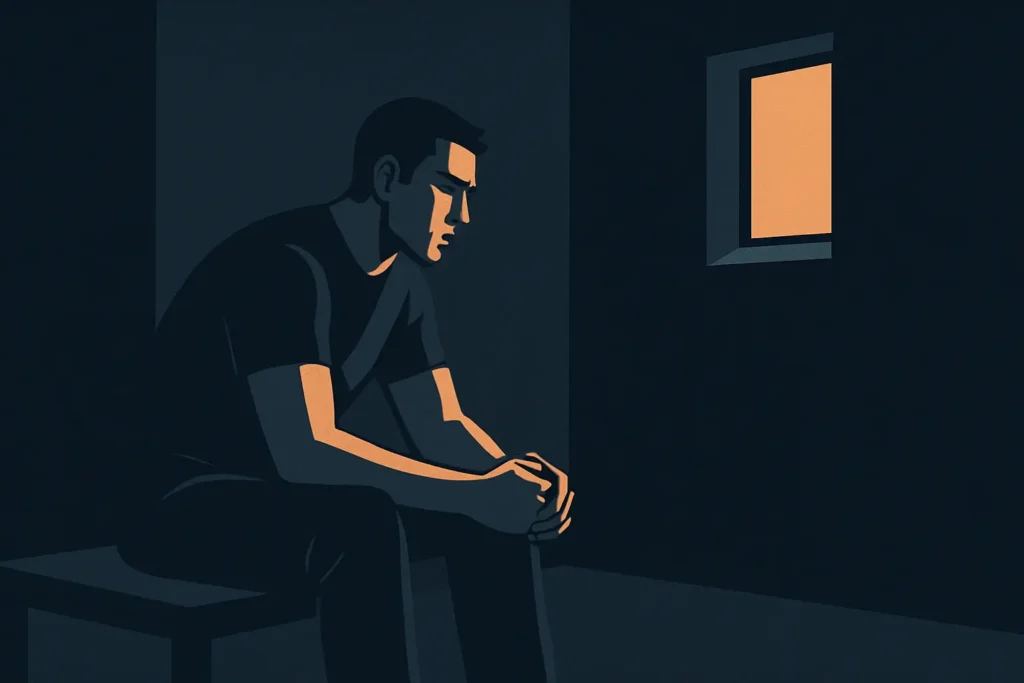
Every man has two lives —
the one he shows the world,
and the one he fights through in silence.
Most men spend their energy polishing the first and neglecting the second.
But the second one — that private, unseen version — is the one that actually decides who you become.
Because when no one’s watching, that’s when the mask falls off.
No more pretending.
No more image.
Just truth.
And the truth is: the man you are in private is the man you really are.
It’s easy to act disciplined when people expect it.
It’s easy to stay focused when accountability’s public.
It’s easy to play strong when you know someone’s clapping for you.
But when the crowd disappears and it’s just you and your impulses — who wins?
That’s the difference between image and integrity.
Most men lose in silence because they’ve never trained for solitude.
They’re so used to being driven by validation that when it disappears, so does their discipline.
You don’t rise in public.
You rise in private — in the moments you think don’t matter.
The skipped workout.
The late-night scroll.
The “just one more” dopamine hit.
Those moments add up.
They’re microscopic, invisible to the world — but they’re carving who you’re becoming.
And every time you choose the easier path, you’re feeding the part of yourself that doesn’t respect you.
That’s the real cost.
Self-control isn’t about impressing anyone.
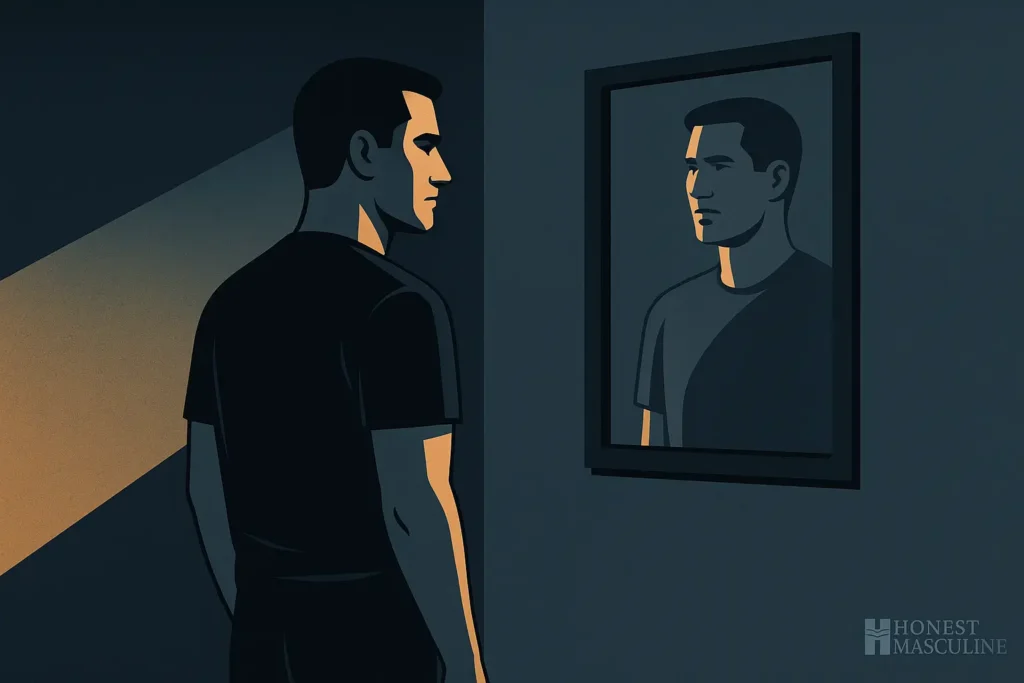
It’s about being able to look in the mirror and know that your habits match your values.
Because if they don’t — you’re not leading yourself, you’re lying to yourself.
And no man can build a life he’s proud of while lying to the one person who knows everything — himself.
Why Most Men Only Have Public Discipline
Most men don’t have discipline.
They have performance.
They can hold it together when people are watching —
in the gym, at work, on social media —
but the second the spotlight turns off, the mask cracks.
Why?
Because their discipline isn’t internal. It’s conditional.
It exists only when someone’s validating it.
And the second that validation disappears, so does their control.
You’ve seen it before — the guy who trains hard all week but binge drinks every weekend.
The entrepreneur who preaches productivity but can’t stay off porn or YouTube at night.
The “motivational” dude online who posts quotes about consistency but hasn’t read a book in six months.
That’s not hypocrisy.
That’s incomplete discipline.
It’s the difference between doing it for approval and doing it from alignment.
Public discipline is powered by ego.
Private discipline is powered by standards.
Ego says, “I want to look strong.”
Standards say, “I want to be strong.”
The first depends on who’s watching.
The second depends on who you are.
And that’s why so many men break when no one’s around —
because their strength was never theirs to begin with.
They were borrowing it from attention.
When you build your discipline for applause, it disappears with the crowd.
But when you build it for self-respect, it multiplies in silence.
The real test of masculine maturity is whether your habits survive anonymity.
Can you train when no one cares?
Can you work when no one’s rewarding you?
Can you stay grounded when no one’s validating you?
Because if you can, you’re dangerous.
You’ve stopped depending on the world to keep you sharp.
And that’s when you cross the line from “motivated man” to mastered man.
The Psychology of Private Discipline — How to Build It
Self-control doesn’t appear out of nowhere.
It’s engineered.
If your environment feeds your weakness, it doesn’t matter how strong your intentions are.
You’ll lose every time.
That’s why building private discipline isn’t about being superhuman —
it’s about removing the bullshit that keeps you distracted, emotional, and reactive.
Here’s how to build that inner architecture of control — one that works even when no one’s watching.
1. Engineer Your Environment
Your willpower is not infinite.
So stop wasting it fighting the same battles every day.
If junk food’s in your house, you’ll eat it.
If your phone’s beside your bed, you’ll scroll it.
If your distractions are within reach, your focus will never be.
Discipline starts with design.
Build your environment so that your bad habits are inconvenient and your good ones are automatic.
Make the right choice the easy one — not the other way around.
2. Create Rituals, Not Rules
Rules rely on memory.
Rituals rely on identity.
When you have to “decide” whether to do something, you’ve already lost half the battle.
Private discipline lives in rituals — automatic, repeatable patterns that eliminate hesitation.
Morning routine.
Workout schedule.
Bedtime shutdown.
You’re not waiting for motivation — you’re following a system that doesn’t care about mood.
Because when you remove the option to fail, you start winning by default.
3. Build Accountability with Silence
Most men think accountability means broadcasting their goals.
It doesn’t.
It means proving them in silence.
When you start chasing internal validation instead of external, you stop needing applause.
And ironically, that’s when people start respecting you more — because your discipline feels authentic.
Keep score quietly.
Track progress privately.
Let the results do the talking.
Real accountability doesn’t need witnesses.
4. Make Failure Expensive
Private discipline only thrives when the cost of breaking it feels real.
Put something at stake — time, money, pride.
Miss a workout? Double your reps tomorrow.
Break your focus block? Delete an app for 24 hours.
Pain cements patterns.
When you attach discomfort to failure, your brain starts to protect discipline the same way it protects survival.
That’s how you rewire your instincts — through earned consequence.
5. Reward Integrity, Not Image
At the end of the day, you have to build a feedback loop that rewards character.
You don’t get dopamine from applause — you get it from alignment.
You start taking pride in doing the right thing even when no one sees it.
Because that’s the kind of victory that actually grows confidence.
Public praise fades.
Private integrity compounds.
And the man who can stand alone with discipline — without needing attention, without needing validation — is the man who’s truly free.
The Shadow Work of Self-Control — Facing Your Triggers
You can’t control yourself until you understand what’s controlling you.
Most men try to build discipline by adding rules, routines, or restrictions —
but they never look at the emotional drivers behind their behavior.
That’s why they relapse.
That’s why they binge.
That’s why they lose control the second life gets heavy.
Because self-control isn’t about fighting impulses — it’s about understanding them.
1. Every Weakness Has a Wound Behind It
You don’t scroll endlessly because you love your phone.
You scroll because you’re avoiding something.
You don’t drink because you like the taste.
You drink because you hate the silence.
You don’t chase pleasure because you’re greedy.
You chase it because you’re empty.
Most men don’t have a discipline problem — they have a pain-avoidance problem.
And until you face that pain head-on, it’ll keep running your life from the shadows.
Self-control begins with honesty:
What are you trying not to feel?
2. Replace Reaction with Reflection
The moment before you give in to a bad habit — that’s the golden window.
Instead of reacting automatically, pause and reflect.
Ask yourself:
- What triggered this urge?
- What am I trying to escape right now?
- What would my highest self do?
That pause is where you start reprogramming your brain.
You can’t eliminate urges, but you can rewire your relationship with them.
Reflection turns emotion into data — and data gives you power.
3. Use Awareness as a Weapon
Most men suppress their impulses.
Strong men study them.
Every craving is a compass pointing to something unhealed or underdeveloped.
When you start tracking your patterns — when you notice what time, what emotion, what situation leads to weakness — you start regaining control.
Because once you know your triggers, they stop being traps.
That’s what awareness does — it turns chaos into clarity.
4. Transform Shame Into Responsibility
Discipline dies in shame.
Every time you mess up and beat yourself down, you’re reinforcing the identity of failure.
But if you replace shame with responsibility, everything changes.
“I failed” becomes “I learned.”
“I slipped” becomes “I adjusted.”
“I broke my word” becomes “I’m building back.”
You can’t hate yourself into discipline.
You can only lead yourself there through honesty, accountability, and forward motion.
Self-control doesn’t mean suppressing your humanity.
It means commanding it.
When you understand your triggers, your patterns, and your pain — you stop being ruled by them.
And that’s when your discipline stops being fragile and starts becoming bulletproof.
Integrity Is the Final Form of Power
The most powerful man isn’t the one who controls others.
It’s the one who controls himself.
Because the man who can’t control his impulses — his anger, his lust, his distractions — will eventually be controlled by them.
That’s why self-control isn’t about repression.
It’s about alignment.
When your actions match your values, your mind gets quiet.
When your habits match your standards, your confidence stops needing proof.
That’s what integrity really means:
You are who you say you are — even when no one’s watching.
And that’s rare.
Most men live double lives — one for the world, one for themselves.
But the ones who live the same way in both?
Those are the men you feel when they walk into a room.
They don’t need to say much.
Their presence speaks for them.
Because integrity gives you something that can’t be faked — certainty.
You know what you stand for.
You know what you’ll tolerate.
You know where you won’t bend.
And that clarity turns into calm power.
You stop chasing validation.
You stop explaining yourself.
You stop negotiating with your own weakness.
You just live your code — quietly, consistently, relentlessly.
That’s the final form of masculine self-control: not effort, but embodiment.
The man who lives in integrity doesn’t need motivation.
He doesn’t need eyes on him.
He just operates — because he’s built a life where his discipline and his identity are the same thing.
And that’s what makes him unstoppable.
Because a man who can’t be bought, tempted, or broken in private…
can’t be controlled by anything in public.
Final Truth-Bomb
No one’s coming to check on you.
No one’s going to clap for your quiet discipline.
And no one’s going to save you from yourself.
That’s the truth most men don’t want to face.
Because self-control isn’t sexy.
It doesn’t get likes.
It doesn’t get applause.
But it’s the foundation every other masculine trait is built on.
Without it, your talent means nothing.
Your words mean nothing.
Your potential means nothing.
But with it — everything changes.
When you build self-control in silence, your results start speaking for you.
You stop chasing attention because you’ve built authority.
You stop proving yourself because you’ve already earned yourself.
That’s what makes men powerful — not noise, not image, but integrity.
Because the man who can control himself, controls his life.
And the man who can control his life, controls his world.
So stop worrying about what people think.
Stop pretending you’re disciplined when you’re not.
And start doing the work no one sees.
The late nights.
The self-restraint.
The private decisions that shape public power.
Because what you do when no one’s watching…
determines who you become when everyone is.
FAQ — The Discipline Reset Series
1. Why is self-control more important than motivation?
Motivation fades. Self-control endures. It keeps you on course when feelings fail you.
2. How can I develop better self-control?
Simplify your environment, build rituals, and train your ability to pause before reacting. Structure beats willpower.
3. What if I keep failing in private?
Failure isn’t final — it’s feedback. Study your triggers, not just your mistakes. Then rebuild stronger.
4. Is self-control about being emotionless?
No. It’s about mastering emotion. You still feel — you just don’t let feeling dictate your choices.
5. How do I know if I have real integrity?
Ask yourself: Would I still make this choice if no one ever found out?
If the answer’s yes — that’s integrity.
👉Want to reclaim your life?
Join My Newsletter The Honest Masculine weekly newsletter — and you’ll get instant access to my (The Masculine Comeback: A 7-Day Reset for Men Who Feel Lost). No fluff, no filters. Just raw truths about breakups, masculinity, fatherhood, and the quiet battles men face alone.
It’s for the man who’s done pretending.

If you like my content? Let me know by Buying me a coffee. Thanks 🙂