
Introduction: PagerGPT Review
Most AI tools promise leverage.
What they actually give you is another thing to manage.
Another dashboard.
Another setup process.
Another “just tweak this once more” loop that quietly eats your time.
I didn’t start using PagerGPT because I wanted to experiment with AI.
I started because I was tired of being the bottleneck.
What Is PagerGPT?
PagerGPT is a no-code AI agent platform that lets you deploy intelligent, conversational agents on your website and digital properties.
In practical terms, it’s a way to have your business respond instantly to visitors—without you being there.
PagerGPT agents can:
- Answer common questions
- Explain your products or services
- Handle first-line customer support
- Capture and qualify leads
- Guide visitors to the right next step
All using your existing content, not generic chatbot scripts.
You don’t build flows.
You don’t write code.
You don’t manage complex logic trees.
You give the agent:
- Clear instructions
- Your website pages, documents, or PDFs
- Context about your offer
And it handles conversations the way a competent human would—minus the delays, fatigue, or inconsistency.
How PagerGPT Is Different From a Typical Chatbot
Most chatbots work like this:
- Pre-written answers
- Rigid decision trees
- Easy to break with unexpected questions
PagerGPT works differently.
It’s trained on your information and responds dynamically, which means:
- Fewer dead ends
- More natural conversations
- Better answers to real questions
Instead of forcing users down a script, it helps them move forward.
What PagerGPT Is Not
PagerGPT is not:
- A magic sales machine
- A replacement for clear messaging
- A fix for a broken offer
It doesn’t invent clarity.
It amplifies what’s already there.
When your content is solid, PagerGPT makes it accessible at the exact moment someone needs it.
The Real Problem Nobody Mentions
Here’s the part most software reviews skip.
Online businesses don’t usually fail because the offer is bad.
They fail because attention leaks.
Someone lands on your site.
They hesitate.
They have a question.
And you’re not there.
Not because you don’t care.
Because you’re human.
You can’t reply instantly to everyone.
You can’t repeat the same explanations forever.
And you definitely can’t stay “on” 24/7 without burning out.
That’s the gap PagerGPT is designed to fill.
Not with hype.
With presence.
What PagerGPT Actually Is (Without the Buzzwords)
PagerGPT lets you create AI agents that handle conversations on your behalf.
That includes:
- Answering questions on your site
- Handling basic customer support
- Explaining your offer clearly
- Capturing and qualifying leads
- Responding instantly, any time of day
No coding.
No complex workflows.
No duct-taping five tools together and hoping nothing breaks.
You give the agent:
- Instructions
- Context
- Your content
And it handles the conversations that don’t need you.
Why This Matters More Than Features
Most reviews obsess over:
- Integrations
- Models
- Pricing tiers
- Technical specs
None of that decides whether a tool earns a permanent place in your business.
What actually matters is simpler:
Does it reduce mental load?
PagerGPT does.
Because it removes the need to:
- Repeat yourself
- Jump between inboxes
- Answer the same questions again and again
- Stay available just in case someone messages
That’s not automation.
That’s relief.
The Feature That Actually Changes Everything
PagerGPT can be trained on your own content.
Your website.
Your PDFs.
Your help docs.
Your product pages.
That matters more than it sounds.
It means:
- No hallucinated answers
- No generic chatbot tone
- No contradictions
The agent responds the way you would — on your clearest, most patient day.
That’s the difference between a chatbot people tolerate and one they trust.
PagerGPT vs Most AI Agent Tools
Most AI agent tools fall into one of three categories.
1. Developer-First Tools
Powerful, flexible, and exhausting.
Great if you enjoy configuration.
Overkill if you just want results.
2. Directory-Grade Chatbots
Feature-heavy.
Generic.
Interchangeable.
They technically work — but nothing about them feels human.
3. PagerGPT-Style Agents
Built for people who value outcomes over tinkering.
If you enjoy tweaking systems endlessly, PagerGPT may feel boring.
If you want conversations handled without thinking about them, it fits immediately.
Who PagerGPT Is For
PagerGPT makes sense if you are:
- A creator selling digital products
- A coach or consultant handling inbound questions
- A solo operator running lean
- A small business owner tired of being “on call”
- Anyone who values leverage over hustle
If conversations slow you down, this tool speeds you up.
Who Should Skip It
This part matters.
Don’t use PagerGPT if:
- You don’t have a clear offer
- You don’t know what problem you solve
- You’re hoping AI will fix confusion
PagerGPT amplifies clarity.
It doesn’t create it.
If your messaging is messy, this will just automate the mess faster.
The Real Advantage Nobody Lists on Comparison Pages
PagerGPT separates your time from your business.
Every conversation it handles is:
- Time you didn’t spend
- Focus you didn’t lose
- Energy you didn’t drain
That’s how businesses scale quietly.
Not by working harder.
By removing friction.
Final Verdict
PagerGPT isn’t exciting.
It isn’t flashy.
It won’t impress people on social media.
It just shows up.
Every time.
With consistency.
And in business, consistency beats intensity every single time.
If you’re serious about leverage — and done being the choke point — this tool earns a real look.
PagerGPT Pricing: What You’re Actually Paying For
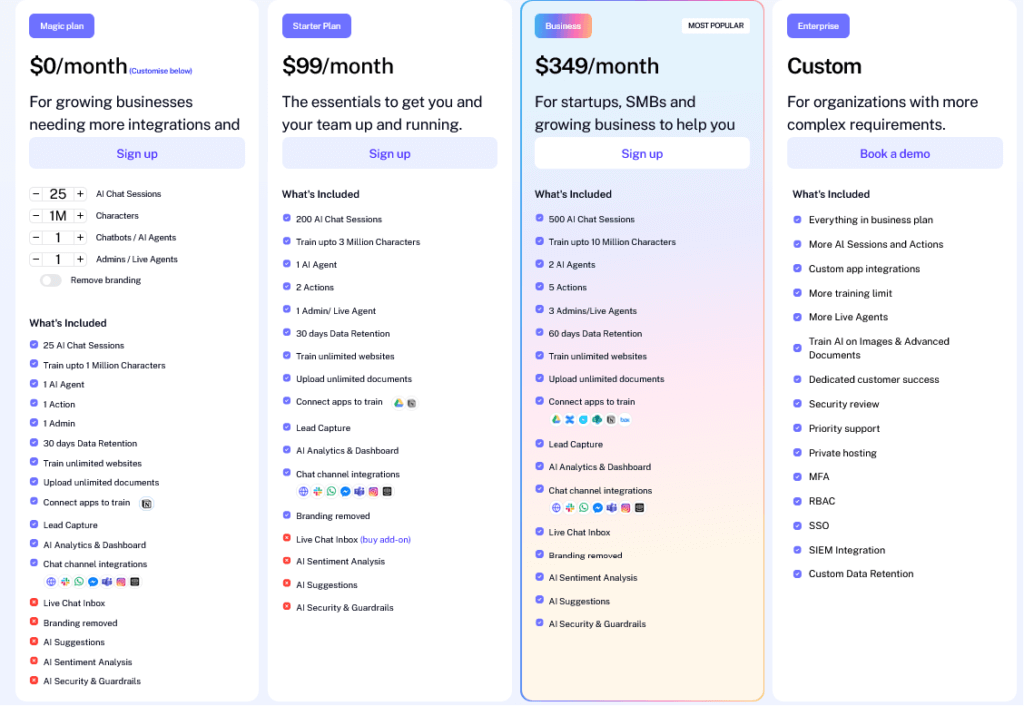
PagerGPT pricing is structured around usage and scale, not feature gimmicks.
You’re paying for how much conversation, training, and autonomy you need — not vague “AI credits.”
Here’s how the plans break down in real terms.
Free / Magic Plan — $0/month
This is a legit starting point, not a fake free tier.
Best for:
Testing the platform, early-stage creators, or very small sites.
What it gives you:
- 25 AI chat sessions
- Up to 1 million characters of training data
- 1 AI agent
- Lead capture and analytics
- Website + document training
What it doesn’t:
- Live chat inbox
- Branding removal
- Advanced AI features
If you just want to see how PagerGPT behaves with your content, this is enough.
Starter Plan — $99/month
This is where PagerGPT becomes useful as a daily tool.
Best for:
Solo operators, consultants, creators, and lean businesses.
What changes:
- 200 AI chat sessions
- Training up to 3 million characters
- 1 AI agent + 2 actions
- Live agent access (admin)
- Unlimited website + document training
- Lead capture + analytics
- Multi-channel chat integrations
You’re no longer “testing.”
You’re delegating conversations.
Business Plan — $349/month (Most Popular)
This is the plan built for real volume.
Best for:
Startups, SMBs, and businesses where conversations directly affect revenue.
What you get:
- 500 AI chat sessions
- Training up to 10 million characters
- 2 AI agents + 5 actions
- Multiple admins / live agents
- Branding removed
- AI sentiment analysis
- AI suggestions
- Security guardrails
- Full analytics + integrations
At this level, PagerGPT isn’t support software.
It’s infrastructure.
Enterprise — Custom Pricing
This is for organizations with:
- Compliance requirements
- Custom integrations
- Advanced security needs
Includes:
- Everything in Business
- More sessions and training limits
- Custom app integrations
- Image + advanced document training
- Dedicated customer success
- SSO, RBAC, MFA
- Private hosting and custom data retention
If you need this, you already know why.
Which Plan Actually Makes Sense?
Here’s the honest answer:
- Just exploring? Start free.
- Handling regular inquiries? Starter is the sweet spot.
- Relying on conversations to convert leads or support customers? Business pays for itself fast.
PagerGPT pricing isn’t cheap — but it’s also not pretending to be.
You’re paying to stop being the bottleneck.
Frequently Asked Questions About PagerGPT
Is PagerGPT worth it for solo creators and small businesses?
Yes — if you’re already getting traffic or inquiries. PagerGPT shines when you have repeat questions, pre-sale hesitation, or support requests slowing you down. If no one is messaging you yet, it’s overkill. If they are, it pays for itself in saved time fast.
How long does it take to set up PagerGPT?
Most people can get a useful agent live in under an hour.
You’re not building logic trees or workflows — you’re giving instructions and content. The clarity of your material matters more than technical skill.
Does PagerGPT replace live chat or human support?
No — and it shouldn’t.
PagerGPT handles first-line conversations: questions, explanations, qualification, and routing. Humans still matter for edge cases and high-touch support. The goal is fewer interruptions, not zero humans.
Can PagerGPT be trained on my own content?
Yes. This is one of its biggest strengths.
You can train it on your website, PDFs, help docs, and product pages so responses stay accurate and on-brand instead of generic or misleading.
Will PagerGPT sound like a generic chatbot?
Only if your content is generic.
When trained properly, the agent mirrors your tone and explanations. It doesn’t invent answers or drift into AI-speak the way many chatbots do.
Is PagerGPT better than other AI agent tools?
That depends on what you value.
If you enjoy tweaking systems and building custom logic, there are more complex tools. If you want conversations handled without thinking about them, PagerGPT is built for that outcome.
What kind of businesses get the most value from PagerGPT?
PagerGPT works best for:
- Creators selling digital products
- Coaches and consultants
- SaaS or service businesses with repeat questions
- Solo operators who can’t be “on” all day
If conversations create friction, this removes it.
What are the limitations of PagerGPT?
PagerGPT won’t fix unclear offers or weak messaging.
It amplifies what you already have. If your content is confusing, it will confidently repeat the confusion. Clarity first. Automation second.