Table of Contents
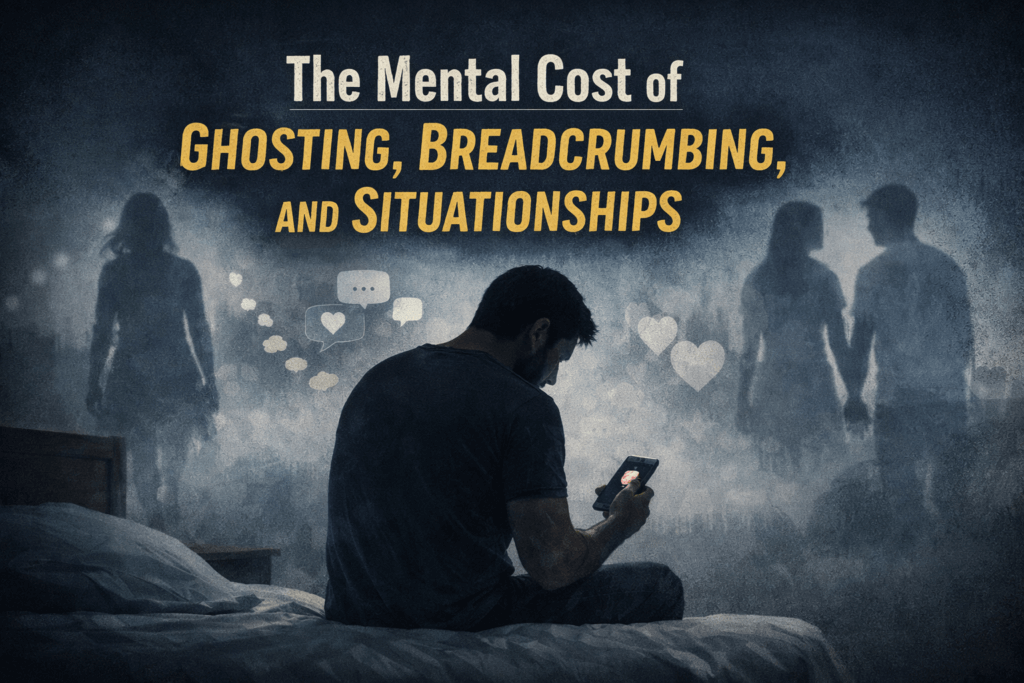
Introduction: The Mental Cost of Ghosting
Modern dating didn’t just change how people meet.
It changed how rejection happens — slower, quieter, and harder to process.
For a lot of men, the damage isn’t dramatic.
It’s subtle. It accumulates.
You don’t get a clear “no.”
You get silence. Mixed signals. Half-interest that never turns into anything real.
And over time, that ambiguity starts to mess with your head.
Why Modern Dating Normalized Emotional Disposability
Modern dating didn’t invent disrespect — it normalized emotional disposability.
Apps, endless options, and low social consequence make it easy to walk away without explanation. There’s no shared circle. No accountability. No need to deal with discomfort.
When someone disappears, it’s rarely framed as cruelty. It’s framed as convenience.
That framing matters.
Because when behavior is normalized, the person on the receiving end starts questioning themselves instead of the system.
Men don’t usually think:
“This environment encourages avoidance.”
They think:
“What did I do wrong?”
That’s how confidence erodes quietly — not through rejection, but through repeated exposure to a structure that avoids responsibility while encouraging emotional access.
This is why ghosting and breadcrumbing feel uniquely destabilizing. They’re not personal failures — they’re byproducts of a low-accountability dating culture.
What Ghosting, Breadcrumbing, and Situationships Really Are
These words get thrown around casually, but their impact isn’t casual.
Ghosting is when communication stops without explanation. No closure. No signal that it’s over. Just disappearance.
Breadcrumbing is intermittent attention — a message here, a compliment there — enough to keep hope alive, never enough to build anything.
Situationships are undefined connections where intimacy exists but clarity doesn’t. No agreement. No direction. No responsibility.
Individually, these might seem minor.
Repeated over time, they create a pattern: emotional uncertainty without resolution.
That’s where the mental cost starts.
Why Ambiguity Hits Harder Than Rejection
Clear rejection hurts — but it ends.
Ambiguity keeps you stuck.
When someone fades instead of leaving, your brain doesn’t know what to do. It stays alert. It keeps scanning.
You replay conversations.
You analyze timing.
You wait longer than you should.
Not because you’re weak — but because the situation never resolves.
This state creates:
- Low-grade anxiety
- Persistent overthinking
- A sense of being “on hold”
- Difficulty trusting your own judgment
Your nervous system stays activated because it never gets a clear signal that it’s safe to move on.
Ambiguity Keeps Your Nervous System Switched On
Your brain treats uncertainty differently than rejection.
Clear rejection activates pain — then resolution.
Ambiguity activates vigilance.
When you don’t know where you stand, your nervous system stays alert:
- Waiting
- Scanning
- Interpreting
That’s not emotional weakness. That’s biology.
The problem is duration.
Short-term uncertainty creates interest.
Long-term uncertainty creates stress.
Men stuck in unclear dynamics often report:
- Trouble focusing
- Restlessness
- Irritability
- Reduced motivation
Not because they’re obsessed — but because their system never gets permission to disengage.
Dating ambiguity isn’t neutral.
It’s a low-grade stressor that compounds over time.
How These Patterns Erode Self-Respect
Most men don’t say this out loud, but it’s there:
“If I mattered, this wouldn’t be happening.”
That thought creeps in quietly.
You start adjusting yourself:
- Sending safer messages
- Avoiding direct questions
- Accepting less effort than you want
Not because it feels right — but because you don’t want to lose what little connection exists.
This is how self-respect erodes — not in one moment, but through small compromises you make to stay emotionally available to someone who isn’t.
The Accumulated Mental Cost for Men
Over time, repeated exposure to unclear dating dynamics leads to:
1. Dating Burnout
You stop feeling curious or hopeful. Dating starts to feel like emotional labor with poor returns.
2. Emotional Numbness
You don’t open as much — not because you’re guarded, but because you’re tired.
3. Increased Self-Doubt
You question your instincts. You second-guess interest. You hesitate to trust momentum.
4. Lower Initiative
Not laziness. Self-protection. You pull back before investing — because investment has felt unsafe.
None of this means you’re broken.
It means your system adapted to inconsistency.
Why This Often Affects Men Differently
Many men were never taught how to process relational ambiguity.
You’re expected to:
- Be confident
- Not complain
- Move on quietly
So instead of talking it through, you internalize it.
Ghosting doesn’t just end a connection — it often ends the conversation with yourself about what you’re feeling.
That’s why the damage goes unnoticed until it stacks up.
How Ambiguity Shapes Future Relationships
Unchecked, these experiences can change how you relate:
- You expect inconsistency even when none exists
- You avoid asking for clarity to “not rock the boat”
- You detach early to avoid disappointment
- You mistake emotional distance for strength
Ironically, the very behaviors that hurt you can turn into habits you repeat — not out of malice, but self-defense.
Reclaiming Mental Clarity and Self-Respect
This isn’t about blaming modern dating or demonizing people.
It’s about how you respond to ambiguity.
Here’s what actually helps:
1. Treat Clarity as a Requirement
Interest that avoids clarity isn’t interest — it’s comfort without commitment.
2. Stop Interpreting Inconsistency as Potential
Mixed signals aren’t depth. They’re data.
3. Shorten the Waiting Window
The longer you wait for clarity, the more power ambiguity has over your mood.
4. Anchor Your Identity Elsewhere
Purpose, structure, friendships, and physical discipline reduce the emotional weight dating carries.
5. Exit Quietly, Not Bitterly
Self-respect doesn’t need confrontation — it needs follow-through.
Leaving unclear situations early is not insecurity.
It’s emotional hygiene.
How Men Slowly Learn to Accept Less Than They Want
Most men don’t enter dating intending to abandon standards.
It happens gradually.
First, you excuse inconsistency.
Then, you rationalize it.
Then, you adapt to it.
You stop asking direct questions because they feel risky.
You lower expectations because “that’s just how dating is.”
You accept half-effort because full effort feels unrealistic.
This isn’t maturity.
It’s conditioning.
And the longer it goes on, the harder it becomes to tell whether you’re being patient — or avoiding self-respect.
The real danger isn’t rejection.
It’s learning to live without reciprocity.
The Honest Truth
Ghosting, breadcrumbing, and situationships don’t destroy men overnight.
They drain men slowly.
They teach you to doubt your instincts.
They train you to accept less than mutual effort.
They make connection feel like something you endure instead of enjoy.
The fix isn’t becoming colder.
It’s becoming clearer.
Dating should add to your life — not keep you suspended in it.
In my full article on Relationships in 2026 I break down the exact scripts men can use to say no without guilt.
👉Want to reclaim your life?
Join My Newsletter The Honest Masculine weekly newsletter — and you’ll get instant access to my (The Masculine Comeback: A 7-Day Reset for Men Who Feel Lost). No fluff, no filters. Just raw truths about breakups, masculinity, fatherhood, and the quiet battles men face alone.
It’s for the man who’s done pretending.
Frequently Asked Questions About Ghosting, Breadcrumbing, and Situationships
Why does ghosting hurt so much mentally?
Ghosting removes closure. Your mind looks for an ending that never arrives, which keeps emotional tension alive. The pain isn’t just rejection — it’s unresolved uncertainty, which creates anxiety and self-doubt over time.
Is breadcrumbing emotional manipulation or just confusion?
Sometimes it’s confusion. Often it’s avoidance. Either way, the impact is the same: you’re kept emotionally engaged without real intention. Intent matters less than outcome — and the outcome is prolonged uncertainty.
What’s the psychological effect of situationships?
Situationships keep you emotionally invested without stability. That lack of definition trains you to suppress your needs and accept ambiguity as normal, which can erode self-respect and trust in future relationships.
Do ghosting and breadcrumbing affect men differently than women?
Many men internalize these experiences rather than process them openly. Because men are often expected to “brush it off,” the stress goes underground — showing up later as burnout, withdrawal, or emotional numbness.
Is it weak to ask for clarity in dating?
No. Asking for clarity is a sign of self-respect. Avoiding clarity to keep someone around is what slowly weakens your position — and your confidence.
How long should you tolerate ambiguity in dating?
Long enough to observe patterns — not long enough to abandon your standards. Repeated inconsistency is already an answer, even if no one says it out loud.
Can ghosting damage long-term confidence?
Yes, especially when it happens repeatedly. Over time, it can make you hesitant to invest emotionally, overly cautious, or doubtful of your own judgment — even with healthy partners.
How do you protect your mental health while dating?
By treating clarity as non-negotiable, maintaining purpose outside dating, and leaving unclear situations early. Dating shouldn’t require you to stay emotionally suspended.
What’s the healthiest response to being ghosted?
Accept the silence as information, not a reflection of your worth. Don’t chase explanations that won’t come. Regain control by redirecting attention to things that ground you — not by waiting.
Is modern dating inherently damaging for men?
Not inherently — but without boundaries, it can become draining fast. The damage comes from prolonged ambiguity, not from dating itself.
If you’re tired of understanding the problem but living with it anyway,
read this.
Not to feel better.
To finally move.