
Table of Contents
Introduction: Discipline vs. Motivation What’s the Difference?
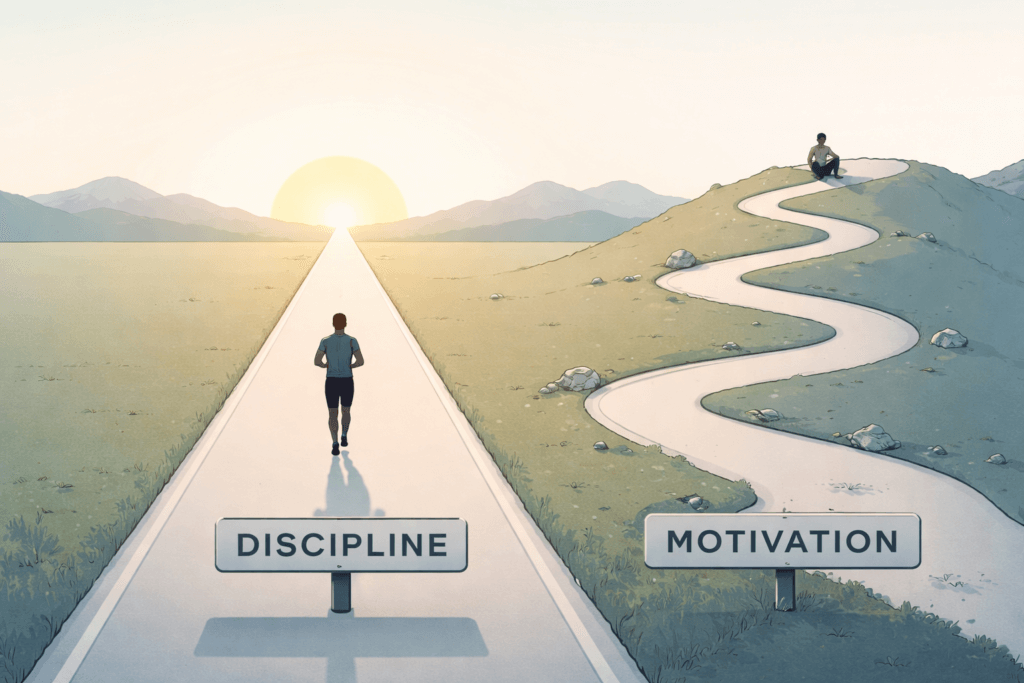
Motivation is a feeling. Discipline is a system. Motivation gets you started when you feel inspired. Discipline keeps you going when you don’t. If you rely on motivation, your effort rises and falls with your mood. If you build discipline, your actions stay consistent even on bad days.
What Motivation Really Is
Motivation is emotional energy. It comes from excitement, fear, urgency, or hope of a payoff. Some days it’s strong. Many days it’s absent.
That’s not a flaw. It’s how humans work. Motivation responds to novelty and reward, which is why it spikes at the start of a goal and fades once the work becomes repetitive or uncomfortable.
If your plan depends on feeling motivated first, you’ve already built in failure.
What Discipline Actually Means
Discipline is the ability to act without negotiating with your mood. It’s not intensity or willpower. It’s structure.
When something is disciplined, the decision has already been made. You don’t ask yourself if you feel like training, writing, or showing up. You follow the rule you set earlier when you were calm and rational.
Discipline removes daily decision-making. That’s why it works.
Why Motivation Keeps Letting You Down
Motivation is unreliable because life is unreliable. Stress, poor sleep, work pressure, relationship problems, and boredom all drain emotional energy.
Most men aren’t lazy. They’re over-relying on motivation in environments that constantly deplete it. Then they blame themselves when they stall.
The issue isn’t character. It’s strategy.
Real-World Examples Men Recognise
The man who only trains when he feels pumped trains inconsistently. The man who trains at the same time regardless of mood trains for years.
The guy who waits to “feel ready” to fix his finances stays stuck. The guy who sets a weekly money check-in does it even when he’d rather avoid it.
One is led by emotion. The other is led by structure.
Discipline Is Built, Not Discovered
Discipline doesn’t appear through inspiration. It’s built through small, repeatable actions that lower friction.
You choose a specific time. You choose a specific minimum standard. You remove choice where possible. Over time, the behaviour becomes automatic, and the need for motivation drops sharply.
This is lived experience, not theory. The more disciplined a habit becomes, the less emotional energy it requires.
The Role Motivation Still Plays
Motivation isn’t useless. It’s just misused.
Motivation is best for starting a new direction, setting goals, or making a clean break from a bad pattern. Discipline is what carries the weight after that initial push.
Use motivation to decide where you’re going. Use discipline to get there.
Common Mistakes That Kill Progress
One mistake is waiting to feel confident before acting. Confidence usually follows action, not the other way around.
Another is setting standards that are too high to repeat on bad days. Discipline collapses if the system only works when life is easy.
A third is confusing discipline with punishment. Discipline isn’t self-hatred. It’s self-respect expressed through consistency.
How to Shift From Motivation to Discipline
Start by shrinking the commitment until it’s almost impossible to skip. Lock it to a time or trigger you already have. Decide in advance what “done” means, even on low-energy days.
When you stop asking yourself how you feel and start following a simple rule, discipline replaces motivation naturally.
FAQs
Is discipline better than motivation?
Discipline is more reliable. Motivation is useful, but discipline is what produces long-term results because it doesn’t depend on mood.
Can you have discipline without motivation?
Yes. Discipline often works precisely because motivation is low. Action taken without emotional drive builds trust in yourself.
Why do I feel motivated but still don’t act?
Because motivation doesn’t remove friction. If the task is unclear or inconvenient, motivation alone won’t carry you through.
Is discipline just willpower?
No. Willpower is momentary effort. Discipline is a system that reduces how much willpower you need.
How long does it take to build discipline?
It varies, but most men notice a shift within weeks once a behaviour is tied to a fixed time and a non-negotiable minimum.
Can discipline make life rigid or joyless?
Only if applied poorly. Good discipline creates freedom by removing chaos and constant decision-fatigue.
Conclusion
Motivation feels good, but it’s fragile. Discipline feels boring, but it works.
If you’re tired of starting strong and fading out, stop waiting for the right feeling. Build a structure that carries you forward whether you’re inspired or not. That’s where real progress comes from.
If you want help applying discipline to confidence, habits, or purpose, that’s the next logical step.
In my full article on Relationships in 2026 I break down the exact scripts men can use to say no without guilt.
👉Want to reclaim your life?
Join My Newsletter The Honest Masculine weekly newsletter — and you’ll get instant access to my (The Masculine Comeback: A 7-Day Reset for Men Who Feel Lost). No fluff, no filters. Just raw truths about breakups, masculinity, fatherhood, and the quiet battles men face alone.
It’s for the man who’s done pretending.
If you’re tired of understanding the problem but living with it anyway,
read this.
Not to feel better.
To finally move.