Why women can trash men online is a question many men ask after watching one post get laughs and another get someone cancelled.
You’ve probably noticed it without needing anyone to point it out.
A woman can post “men are trash” and get laughs, likes, and agreement.
A man posts something equally blunt about women and suddenly it’s screenshots, reports, employer emails, and apologies.
This isn’t about being overly sensitive.
It’s about recognising a pattern that keeps repeating and understanding why it exists—so you don’t walk straight into it.
This article explains the double standard calmly, without rage or cope, and shows you how to navigate it without silencing yourself or blowing up your life.
This article explains why women can trash men online while men face harsher consequences for the same behaviour.
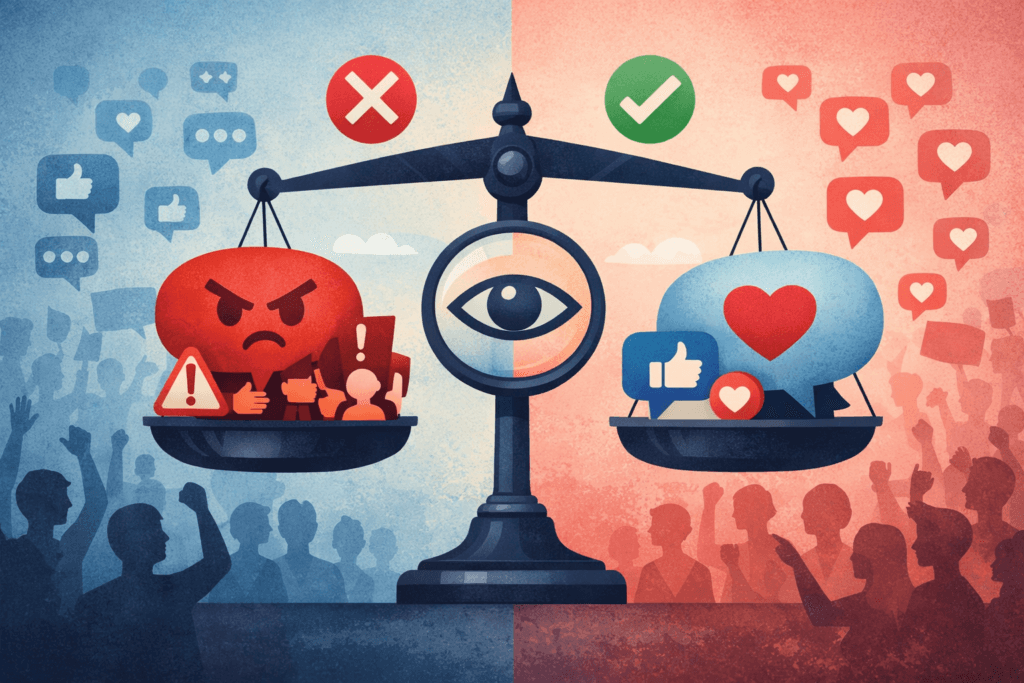
Women can trash men online with fewer consequences because criticism of men is widely treated as “punching up,” while criticism of women is framed as “punching down.” That framing affects how people interpret intent, how content is reported, and how platforms enforce rules. It isn’t fair, but it is consistent—and ignoring it is how men get cancelled.
What the double standard actually is
This isn’t about individual women having special privileges or men being uniquely oppressed.
It’s about how online spaces interpret categories.
Men are generally treated as the default power group. Women are treated as the protected group. Once that assumption is in place, everything else follows.
When women generalise about men, it’s usually read as:
- Venting
- Trauma response
- Social commentary
- Dark humour
When men generalise about women, it’s more likely read as:
- Hostility
- Entitlement
- Threat
- Hatred
Same language. Different moral framing.
Platforms don’t judge based on philosophical fairness. They judge based on perceived risk. And content that looks like it could spark accusations of misogyny is considered high risk.
Why this double standard exists
1. The “punching up vs punching down” lens
Modern discourse is heavily shaped by power narratives.
Men are assumed to have more power as a group, regardless of your personal circumstances. Attacking the powerful is framed as critique. Attacking the protected is framed as harm.
This lens doesn’t care if you’re broke, depressed, or anonymous online. It only cares which box you’re placed in.
2. Platform incentives, not moral consistency
Social media platforms don’t want fairness. They want stability.
They respond to:
- Volume of reports
- Media backlash risk
- Advertiser comfort
Content critical of women triggers faster outrage cycles and press narratives. Platforms pre-emptively clamp down to avoid controversy. Content critical of men rarely creates the same external pressure.
Moderation isn’t justice. It’s damage control.
3. Reporting behaviour and social coordination
Another uncomfortable truth: content only gets punished when it’s reported.
Women are generally quicker to mobilise reporting campaigns. Men are more likely to argue in replies, quote-tweet angrily, or “ratio” posts instead.
Arguing does nothing. Reporting triggers enforcement.
The result is asymmetric consequences, even if the rules are technically “neutral.”
How this shows up in real life
You see it in viral posts that openly mock or dehumanise men and stay up indefinitely.
You see it when male creators lose accounts over a single badly worded joke, even if their intent was obvious.
You see it when employers quietly distance themselves from men who get labelled online, not because they’re guilty, but because they’re risky.
And you feel it when you start self-censoring—not because you’re wrong, but because you know the cost of being misunderstood is higher for you.
That pressure is real, and pretending it isn’t just leaves men confused and angry.
What to do about it (without getting cancelled)
This isn’t about shutting up. It’s about speaking intelligently.
1. Criticise behaviours, not entire groups
“Some dating behaviours reward manipulation” is harder to weaponise than “women are manipulative.”
Precision protects you.
2. Remove heat, keep substance
Anger reads as threat online, especially when it comes from men. Calm language travels further and survives longer.
3. Assume hostile interpretation
Write as if someone is actively looking for the worst possible reading of your words—because often, they are.
4. Don’t process emotions publicly
Social media is not your journal. Venting feels good for five minutes and costs you months of cleanup.
5. Choose impact over validation
You don’t need to “win” comments sections. You need to protect your reputation, your work, and your future options.
None of this is weakness. It’s situational awareness.
Common mistakes men make
The first mistake is assuming fairness. Platforms are not courts.
The second is doubling down when criticised. Screenshots outlive explanations.
The third is turning this into an identity grievance. That path leads to bitterness, isolation, and worse decision-making.
The goal isn’t to prove the world is unfair. The goal is to live well inside the world that exists.
FAQs
Is this a conspiracy against men?
No. It’s the result of incentives, narratives, and risk avoidance colliding. Systems drift toward what causes the least backlash.
Do women ever get cancelled for trashing men?
Yes, but it’s rarer and usually tied to additional factors like threats, workplace policies, or repeated behaviour.
Is it better for men to stay silent online?
Not silent—selective. Speak when it adds clarity or value. Stay quiet when it only adds noise.
Can men criticise women at all?
Yes. Critique actions, ideas, and systems. Broad insults are what trigger consequences.
Will this double standard change?
Possibly, over time. But acting as if it already has is how people get burned.
What’s the healthiest response emotionally?
Accept the asymmetry without letting it define you. Build a life that doesn’t depend on online approval.
Conclusion
The online world isn’t neutral, and it never has been.
Some voices are treated as critique. Others are treated as threat. Once you understand that, you stop taking it personally and start acting strategically.
You don’t need to rage about the double standard.
You don’t need to deny it either.
See it clearly. Speak carefully. Protect what matters.
That’s not submission.
That’s maturity.
In my full article on Relationships in 2026 I break down the exact scripts men can use to say no without guilt.
👉Want to reclaim your life?
Join My Newsletter The Honest Masculine weekly newsletter — and you’ll get instant access to my (The Masculine Comeback: A 7-Day Reset for Men Who Feel Lost). No fluff, no filters. Just raw truths about breakups, masculinity, fatherhood, and the quiet battles men face alone.
It’s for the man who’s done pretending.

If you like my content? Let me know by Buying me a coffee. Thanks 🙂